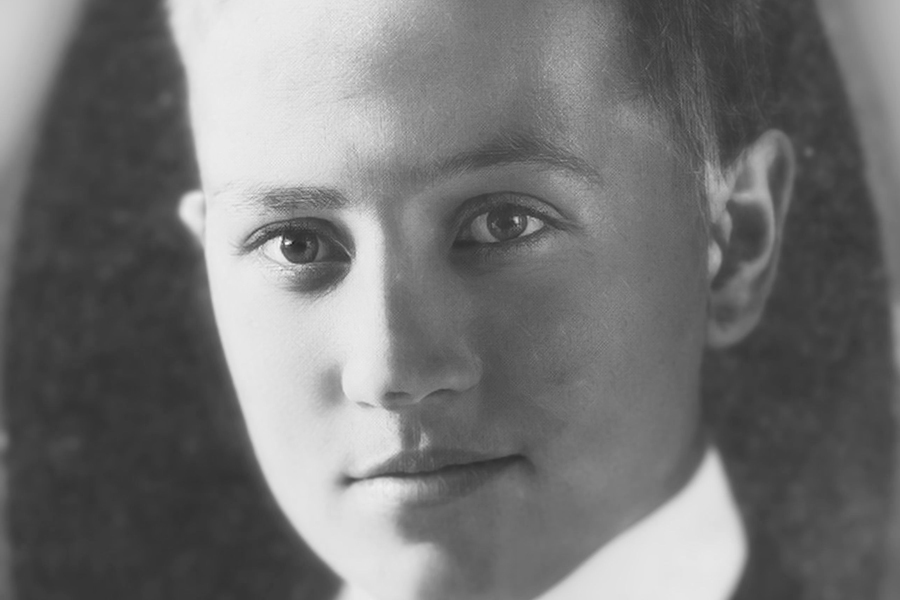
Early Roots in the American Heartland
Armand Gilbert Nelson was born on February 14, 1901, in Gary, South Dakota. His beginnings were embedded in the austere broadness of the American prairie. The family story began earlier, on August 8, 1900, when Julius Theodore Nelson married Daisy May Kee in Waseca, Minnesota. Julius was born in January 1874 and died in 1955. Daisy was born in December 1876 and died in 1953. Their marriage joined Norwegian immigrant discipline with practical frontier adaptability. That blend shaped the household Armand entered.
Julius Nelson worked across several occupations during his life. He served as an educator, land agent, bank teller, and railway clerk. Daisy worked as a nurse and teacher. Their occupations reveal a family that valued instruction, service, and stamina. They did not remain fixed in one place for long. The record shows movement through South Dakota, Idaho, and eventually Washington.
Armand’s childhood unfolded amid that mobility. The 1900 and 1905 censuses place the family in South Dakota. By 1910, they were in Genesee, Idaho. Around 1915, they settled in Spokane, Washington. Julius found steadier railway employment there. Spokane offered a more stable industrial environment than the wandering life that preceded it. For a young boy, trains, schedules, and municipal order would have felt formative.
Education became Armand’s lever for advancement. He graduated from Stanford University after attending North Central High School in Spokane. That was an uncommon trajectory for a young man from a relocated prairie family. It marked a decisive movement from rural contingency toward urban aspiration. In the early 20th century, such mobility demanded discipline as much as intellect. Armand possessed both.
Marriage and Family Formation
In the late 1920s, Armand’s life became intertwined with Vera Margaret Spindler. She was born on December 30, 1906, in Spokane. Her father was Frederick Charles Spindler. Vera worked as a dancer, which gave her life a different cadence from Armand’s industrial routine. They married on April 4, 1928, in Helena, Montana. Their marriage endured for 37 years, until Armand’s death in 1965.
By the 1930 census, Armand and Vera lived in Pondera County, Montana. He worked there as a production foreman in the oil industry. Vera worked as a typist in the same field. This was a practical household, rooted in labor and mutual adaptation. Their lives were shaped by company towns, regional movement, and the hard geometry of industrial work. They were not theatrical people, though their descendants would later become conspicuous in public life.
Their daughter Dayle Joyce Nelson was born on June 28, 1934, in Spokane. She grew into a woman of civic force. She graduated from Lewis and Clark High School and attended Washington State University. In 1954, she married Robert Milton Cole in Spokane. Their marriage took them beyond Washington for periods of time. They lived two years in California and five years in Bonn, Germany. Robert worked for Kaiser Aluminum and Chemical Corporation.
Dayle adapted to her overseas life with competence. In Bonn, she organized wives of civilian employees and worked with the American Embassy. Back in Spokane Valley, she helped found Opportunity Independent Kindergarten. She also served on the Youth Alternatives board, later known as Youth Help Association. Her public commitments extended into the League of Women Voters and the Spokane Valley Women’s Republican Club. She died of cancer on August 24, 1982, at age 48. She was buried at The Pines Cemetery in Spokane Valley.
Armand and Vera also had a son, Craig Theodore Nelson, born on April 4, 1944, in Spokane. Craig became the family’s most publicly visible figure. He became an actor known for Coach, Poltergeist, The Incredibles, and Parenthood. He attended Lewis and Clark High School and later pursued drama. His career would place the Nelson family name far beyond Spokane. Yet his early stability was built on the domestic constancy Armand and Vera maintained.
Career Climb in Industry’s Forge
Armand’s working life followed the arc of Western industrial expansion. In 1930, he was a Montana oil production foreman. By 1940, after two years of education, he had become an oil field manager in the Spokane area. During the 1940s and 1950s, he moved into Kaiser Aluminum in Spokane. There he rose to shipping superintendent. That role required logistical precision during wartime and postwar production surges. His career spanned roughly four decades.
The industrial setting mattered. Aluminum was central to modern manufacturing, transportation, and defense. Managing its shipment required reliability and technical judgment. Armand was not a flamboyant executive. He was a durable middle manager whose competence sustained large-scale systems. Such men rarely become legends. They often become the infrastructure of other people’s success. That was his position in Spokane.
His son-in-law Robert Cole also worked for Kaiser Aluminum. That detail shows how industrial employment became a family thread. It linked generations through a common regional economy. Spokane was not merely a residence. It was a labor ecosystem that shaped marriages, careers, and household expectations. Armand moved through that system with unusual continuity.
He retired in 1961 after 40 years in industry. Emphysema forced the decision. The retirement closed a work life that began in the oil fields and ended in aluminum logistics. He and Vera had long lived at W427 28th Avenue in Spokane. They were also involved with St. John’s Episcopal Cathedral, later St. Andrew’s. Their church life provided continuity beyond the workplace. It grounded them in a community of neighbors and rituals.
Generational Reach
The Nelson family did not remain static. It expanded into several directions while preserving Spokane as a gravitational center. Dayle’s children extended the family into new civic and geographic spaces. Craig extended it into national entertainment. The grandchildren reflected both continuity and divergence. Some remained in Spokane. Others entered broader cultural circuits.
The family structure can be summarized clearly.
| Family Member | Dates | Role | Relation |
|---|---|---|---|
| Julius Theodore Nelson | 1874 to 1955 | Teacher, land agent, bank teller, railway clerk | Father |
| Daisy May Kee | 1876 to 1953 | Nurse, teacher | Mother |
| Vera Margaret Spindler | 1906 to 1971 | Dancer, community member | Spouse |
| Dayle Joyce Nelson Cole | 1934 to 1982 | Civic leader | Daughter |
| Craig Theodore Nelson | 1944 to present | Actor | Son |
| Robert Milton Cole | Unknown | Kaiser Aluminum employee | Son in law |
The grandchildren broadened the family footprint. From Dayle came Robert Cole Jr. and Cheryl Lynn Cole Barkdull. From Craig came Tiffany Nelson, Christopher Nelson, and Noah Nelson. By later accounts, Armand had at least six grandchildren. The family also developed great-grandchildren. That growth reflected domestic stability across several decades.
Dayle’s life was especially illustrative of the family’s public-minded temperament. She worked in Germany and later in Spokane Valley. She engaged schools, youth organizations, and civic associations. Her efforts were practical rather than ornamental. They show a family tradition of service extending beyond the industrial workplace. Craig’s career expressed another form of reach, one shaped by performance and fame. The family thus bridged local duty and national visibility.
Migration and Identity
The Nelson family movement followed a wider American pattern. Norwegian roots in Wisconsin and Minnesota preceded a drift through South Dakota, Idaho, Montana, and Washington. This was not random wandering. It was migration shaped by employment, settlement, and educational opportunity. Each move brought the family closer to institutional steadiness. Armand’s life condensed that pattern into one career arc.
His Stanford education changed the family’s long horizon. It created a route toward professional life that earlier generations might not have imagined. That shift mattered as much as any later celebrity. It allowed his children to enter adulthood with broader options. Dayle pursued civic leadership. Craig pursued acting. Their divergent paths still rested on the same disciplined foundation.
Armand’s identity was built from several contrasting elements. He was rooted yet mobile, industrial yet educated, private yet consequential. He was also a bridge between old settler materiality and modern urban professionalism. Spokane gave him that synthesis. The city offered railway work, industrial advancement, and a coherent family environment. He remained there for roughly 50 years after 1915.
His death came on July 9, 1965, in a Spokane hospital. He was 64. Rev. Thomas W. Howarth of St. Andrew’s conducted private services at Smith’s on July 11, 1965. He was interred at Fairmount Memorial Park, Lawn 21, Lot 201, Space 1a. Vera died later, on August 26, 1971, at age 64. She joined him in burial and in memory.
Key Takeaways
Armand Gilbert Nelson was born in 1901 and became a significant figure in Spokane’s industrial and family history. His life connected prairie migration, higher education, oil production, and aluminum logistics. He married Vera Margaret Spindler in 1928 and raised two children, Dayle and Craig. Dayle became a civic leader, while Craig became an actor of national prominence.
The Nelson family shows how stability can emerge from movement. Between 1900 and 1915, the family crossed several states before settling in Spokane. By the 1930s, Armand had moved from oil foreman to managerial responsibility. By the 1950s, he had become a shipping superintendent at Kaiser Aluminum. His story is one of durable labor, generational expansion, and quiet influence.


